Sourcing managers at established fashion brands rarely lose sleep over finding fabric — they lose sleep over fabric that doesn't show up on time, doesn't match the last batch's color, or comes from a supplier who can't explain where the raw material actually came from. As global brands accelerate a China Plus One diversification strategy, bulk fabric sourcing from India has moved from a backup option to a primary line in the sourcing playbook.
India's textile and clothing exports reached about $36.55 billion in FY25, with the US making up almost 30% of that trade. As global retailers like Gap, H&M, Zara, and Uniqlo move away from being dependent on just one country, they have placed more orders in India. This guide explains how big fashion brands, private labels, and clothing makers set up a reliable bulk sourcing program, as well as what makes a scalable partner different from a sourcing risk.
Quick Answer: What Bulk Fabric Sourcing from India Actually Requires
Bulk fabric sourcing from India works best when a brand consolidates sourcing, processing, and quality control under one accountable partner instead of coordinating many fragmented suppliers. Done well, it delivers competitive per-meter pricing, predictable lead times, and compliance-ready documentation without the fragmentation risk of managing five or six vendors for a single production run.
Bulk fabric sourcing from India works best when a brand puts all of its sourcing, processing, and quality control under the direction of a single partner, rather than coordinating a bunch of different suppliers. When done right, it gives you a competitive price per metre, predictable lead times, and documentation that is ready for compliance without the risk of managing five or six vendors for a single production run.
- Scale range: Reliable Indian sourcing partners now support programs from initial sampling through 20,000+ meters per month, with access to multi-million-meter mill capacity for peak-season demand.
- Lead time: Depending on the type of fabric, how complicated the dyeing or printing is, and the size of the order, bulk fabric orders usually take 3 to 6 weeks to process in India before they can be sent abroad.
- Compliance: Export-ready suppliers should carry or work within frameworks such as GOTS, OEKO-TEX, SEDEX, and ISO 9001, verifiable through documentation, not just a logo on a website.
- Fabric range: Mature sourcing platforms Fabriclore now offer access to 5,000+ fabric options spanning natural, sustainable, and blended textiles — a meaningfully wider base than a single regional mill can offer.
- Best fit: For supply chain resilience, brands that have programs that run throughout the year, private label lines, or production that isn't limited to one country.
Why India Is Back at the Center of Global Sourcing Conversations
For years, sourcing conversations treated India as a cost play. That framing is outdated. India's textile and apparel exports have grown across more than 120 markets, with ready-made garments contributing the largest single share, followed by cotton and man-made textiles. The shift isn't just about volume — it's about manufacturing depth: buyers can now source raw fiber, processed fabric, and finished garments within the same ecosystem.
That depth is regional, not uniform — and Rajasthan is one of its clearest examples and where Fabriclore is based. Jaipur was named a UNESCO Creative City of Crafts and Folk Art in 2015, specifically for its generations-deep expertise in hand block printing and dyeing — the same foundational techniques underpinning today's industrial digital and rotary printing at scale. PM MITRA textile parks are reinforcing this nationally too. However, supply capacity hasn't yet fully absorbed the volume diverting from China — meaning partner selection still matters more than the region alone.
What this means for a sourcing manager: it's a question of finding a partner — in a region with real, generational manufacturing depth like Rajasthan — whose scale, documentation, and process maturity actually match an enterprise production calendar.
The Core Structure of a Bulk Sourcing Program

A well-developed program for bulk fabric sourcing from India is made up of four steps that work together. The biggest source of supply chain risk is when you treat each of these as a separate relationship with a different vendor.
1. Fabric Discovery and Validation
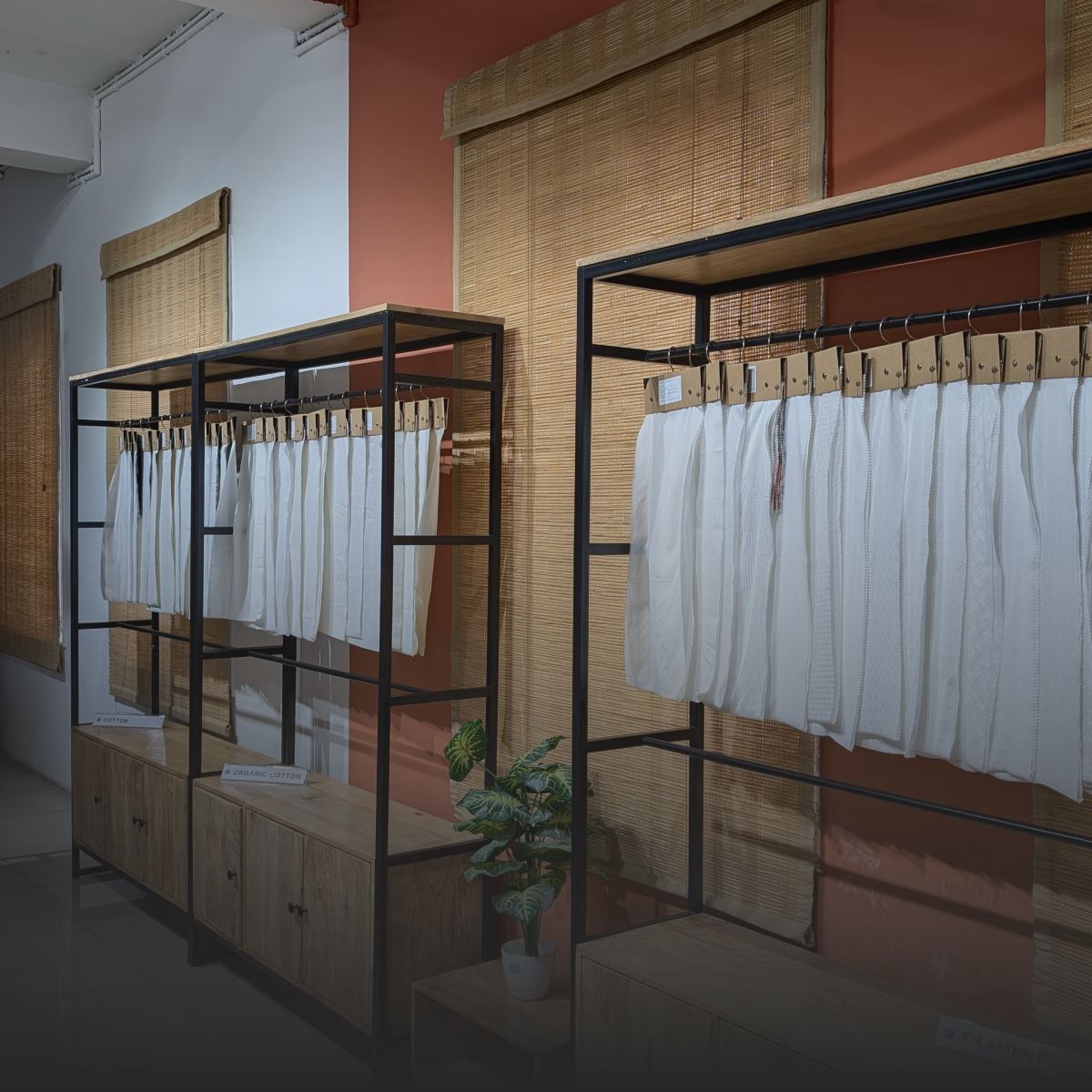
Before ordering a single metre, a brand needs to make sure that the fibre content, weave, weight, and hand-feel match its design goals. It's best to do this against a wide, centralised fabric catalogue instead of a single mill's limited stock. With Fabriclore's 5,000+ fabric options in natural, sustainable, and blended textiles, a design team can quickly narrow down their choices and test them out in person, instead of having to go back and forth with several regional providers for weeks.
2. Processing: Dyeing and Printing at Scale
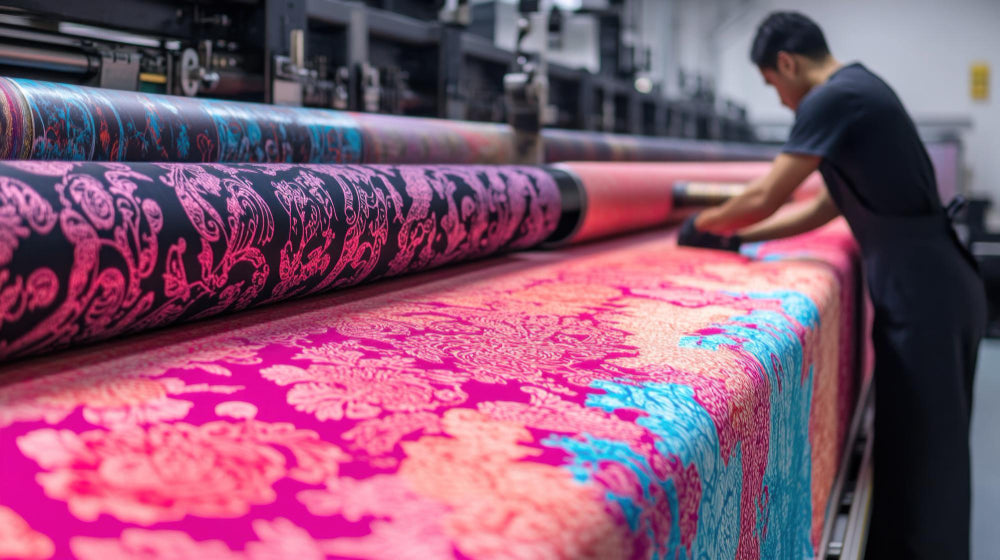
This is where most of the quality risk in bulk orders comes from. There is more to being able to run dye lots under controlled, repeatable conditions than just being able to run one good sample. This is what makes batch-to-batch colour consistency, colourfastness, and shrinkage control possible.
A partner that has been dying and printing for at least ten years and can do both digital printing and traditional rotary printing is usually better able to keep the quality of a 10,000-meter run than a smaller job-work printer that is only good for one-time orders.
3. Distributed Manufacturing Capacity
No mill can reliably handle the high volume of every brand during the busy season. The better model is a distributed manufacturing network, which is a sourcing partner that keeps relationships with multiple verified mills and processing units. This way, production can be scaled up during busy times without the brand having to find and check out a new factory every time capacity runs low. The main difference between a trading agent (someone who sells capacity they don't own) and a vertically integrated partner is that the latter can reroute production across a verified network while still having a single point of responsibility.
4. Garment Manufacturing and Private Label Production
Private label and custom garment manufacturing close the loop for brands that want to get both fabric and finished goods from the same partner. This lowers the risk of the handoff that happens when a fabric seller and a cut-and-sew factory are handled as two separate, uncoordinated vendors.
Supply Chain Visibility: The Differentiator Most Brands Underweight
What really causes delays? Ask any procurement head who has overseen an offshore production run, and they won't say the factory was slow. Not being able to see that a dye lot failed quality checks until three weeks after the shipment was supposed to arrive.
End-to-end order lifecycle automation — Fabriclore's ability to keep track of sampling, dyeing, printing, and production progress in one clear system is becoming a real way to stand out from other Indian sourcing partners, not just a tech feature. For a brand that sells more than one SKU during different seasons, this level of visibility is what turns a sourcing relationship into a predictable planning input instead of a regular fire drill.
If you ask any procurement head what really delays things, they won't say the factory was slow. It's not being able to see—not finding out that a dye lot failed quality checks until three weeks after the shipment was supposed to arrive.
Fabriclore's process is built around end-to-end order lifecycle automation, which means that sampling, dyeing, printing, and production status can all be seen in one system. This is becoming a real differentiator among Indian sourcing partners, not just a feature. This makes a buying relationship less of a fire drill and more like a planning tool for a brand that has multiple SKUs that change with the seasons.
|
Sourcing Model |
Vendor Coordination |
Quality Consistency |
Visibility |
Best Fit |
|
Multiple independent vendors (mill + dyer + printer + factory) |
High effort, brand-managed |
Inconsistent across handoffs |
Low — status lives in emails and calls |
Brands with in-house sourcing teams and time to manage it |
|
Trading agent / broker |
Low effort, agent-managed |
Variable — agent doesn't control production |
Limited — agent reports secondhand |
Smaller orders, lower stakes |
|
Vertically integrated sourcing partner |
Low effort, single point of contact |
Controlled through in-house or verified network processes |
High — order-lifecycle tracking |
Multi-season, bulk, or private label programs |
What Scalable Actually Means in a Sourcing Contract
The majority of the time, brands ask their suppliers if they can scale without being clear about what that means. There are three clear things it should mean:
- Volume flexibility — Being able to go from a low-MOQ sample order to a production run of more than 20,000 meters per month, with access to a factory network that can produce millions of meters during peak demand, all without having to start over with the relationship.
- Predictable, not just fast, lead times — It's better to have a partner who can commit to a consistent turnaround window throughout the year than one who is sometimes quick but hard to predict.
- Pricing transparency at volume — Instead of negotiating each cycle on a quote-by-quote basis, the per-meter price stays the same or gets better over time as the order size grows.
Compliance and Documentation: What Procurement Heads Should Actually Verify
There is value in certifications, but a supplier's logo on their website is not proof. A strict process for buying things makes sure that:
- GOTS (Global Organic Textile Standard) — Currently on Version 7.0 (effective since March 2024, with due-diligence requirements aligned to UN and OECD human rights guidance). Ask for the current scope certificate, not a static badge — GOTS 8.0 is already in early development, and certification scope can change between audit cycles.
- OEKO-TEX — verifies the fabric is free from harmful substances at the finished-product level; ask which specific OEKO-TEX standard applies (Standard 100 is the most common for apparel).
- SEDEX — audits labor practices and ethical sourcing; request the SMETA audit report directly, not just membership confirmation.
- ISO 9001 — a quality management system certification; useful as a baseline but should be paired with actual batch-level testing data (shrinkage, colorfastness, tensile strength) rather than treated as sufficient on its own.
Practical recommendation: Build compliance verification into the sourcing contract itself — require current scope certificates and recent audit reports as a condition of the first bulk order, not as an afterthought after the relationship is established.
Sustainable Fabric Sourcing at Bulk Volume

Sustainability standards used to be a marketing choice, but now they are a real way to buy things, especially for brands that sell in the EU and North America. Fabriclore, as a real bulk sourcing partner, should offer options for sustainable fibres on the same scale as regular fabric, not as a small, separate eco line. In most cases, this includes:
- Organic Cotton — Grown without synthetic pesticides, GOTS-certifiable at the finished product stage.
- TENCEL™ — A branded lyocell/modal fiber produced with a closed-loop solvent process.
- EcoVero™ — A certified sustainable viscose produced with significantly lower emissions and water impact than generic viscose.
- Modal and Linen — Natural or semi-synthetic fibers increasingly requested for their biodegradability and lower water footprint relative to conventional cotton in certain growing regions.
One real differentiator is that you can get these in bulk, with the same lead-time reliability as regular fabric. Many smaller suppliers can give sustainable fabric in sample amounts, but it can be hard to keep a steady supply when an order goes up to thousands of meters.
Common Mistakes Large Brands Make When Sourcing Bulk Fabric from India
- Treating fabric, dyeing, printing, and manufacturing as four separate vendor relationships. Every handoff between vendors is a point where quality consistency and timeline accountability can break down.
- Verifying certifications once and never again. Certification scope and status can change between audit cycles — build re-verification into every major order, not just the first one.
- Underestimating the gap between sample quality and bulk-batch quality. A perfect sample doesn't guarantee dye-lot consistency across 15,000 meters — ask specifically how a supplier controls for batch-to-batch variation.
- Choosing a trading agent when the brand actually needs a manufacturing partner. Agents can be efficient for smaller, lower-stakes orders, but they don't control production — which limits their ability to fix a problem mid-run.
- Ignoring order-lifecycle visibility. Having a supplier that can't reveal real-time sampling, dyeing, and production progress forces a brand to speculate.
Final Thoughts: Building a Sourcing Strategy, Not Just a Supplier List
In 2026, the brands that get the most out of bulk fabric sourcing from India aren't the ones that look for the lowest price. Instead, they create a sourcing framework with fewer, more accountable partners, genuine compliance verification, and real visibility from fibre to finished fabric.
As India's textile export ecosystem expands and global demand shifts, firms who pick suppliers strategically rather than procedurally have a chance.
Planning your next season's fabric program? Talk to a Fabriclore sourcing specialist about your volume requirements, compliance needs, and lead-time targets.
FAQ’s
What Does Bulk Fabric Sourcing From India Typically Cost Compared To Other Regions?
India's per-meter prices are usually the same as or lower than those in other sourcing areas. However, the difference has become smaller as demand has moved out of China. For big brands, total landed cost and reliability are more important than headline per-meter price alone. This includes things like consistent lead times, compliance costs, and less work that needs to be redone because of quality issues.
How Long Does A Typical Bulk Fabric Order From India Take?
Before shipping to other countries is added, domestic production usually takes 3–6 weeks, but this depends on the type of fabric, how complicated the dyeing or printing is, and the size of the order. Brands that have programs for more than one season usually lock in production times ahead of time to avoid having to wait too long during times of high demand.
What's The Difference Between A Trading Agent And A Vertically Integrated Fabric Supplier?
A supplier that is fully integrated, like Fabriclore, handles sourcing, processing, and manufacturing all within a trusted network with a single point of accountability. An agent, on the other hand, sells capacity that they don't control.
Which Certifications Should A Large Fashion Brand Require From An Indian Fabric Supplier?
For organic claims, at the very least, ask for current GOTS certification (Version 7.0), the relevant OEKO-TEX standard for chemical safety, a recent SEDEX/SMETA audit report for labour compliance, and ISO 9001 for quality management. Check all of these directly with current paperwork instead of relying on a logo.
Can Indian Suppliers Support Both Low-Moq Sampling And Large-Scale Bulk Production?
Yes, and increasingly so. Mature sourcing platforms are set up to support a brand from the first low-MOQ samples all the way through production plans that make more than 20,000 meters of fabric every month. As order sizes rise, distributed manufacturing networks are used to add more capacity.
Why Are Global Brands Increasingly Sourcing From India Instead Of Relying Solely On China?
Through a China Plus One approach, brands are putting supply chain resilience above all else. India has a lot of infrastructure for making yarn, fabric, and finished clothes all in one ecosystem. This is made possible by government investments in infrastructure like the PM MITRA textile parks. However, because of limited capacity, it is still important to be careful when choosing a supplier.
What Sustainable Fabric Options Are Available At Bulk Volume From Indian Suppliers?
It's becoming easier to get large amounts of organic cotton, TENCELTM, EcoVeroTM viscose, modal, and linen from well-known sourcing platforms instead of just small samples. However, brands should make sure that a supplier can keep a steady supply of sustainable fibres in the amount they need before placing an order for the whole season.
We also happen to be a magnet for suggestions, and would love to catch yours….throw us yours at hello… @fabriclore.com
Learn, Create & Grow with us