These days, exporting cloth isn't just about price or quality. It has to do with proof. Buyers around the world, especially in the US, UK, and Europe, want to know that environmental, safety, and moral standards are being met. Certifications like GOTS and OEKO-TEX are now important factors in deciding where to buy. Knowing about these certifications is no longer optional for Indian exporters—they need to understand them to enter high-end markets, build trust, and avoid costly rejections. This guide explains what these licenses mean, why they're important, and how exporters can meet the needs of people around the world.
Why Certifications Matter in Fabric Export
Getting a fabric certification helps buyers and sellers trust each other. Compliance gaps mean that even high-quality fabric can be turned down without them.
Key Reasons:
- Required by international brands and retailers.
- Ensures product safety and chemical compliance.
- Builds long-term buyer confidence.
- Enables entry into regulated markets.
To sum up, certifications lower the danger for both the seller and the buyer.
Overview of Major Textile Certifications

As demand for fabric exports from India grows worldwide, buyers are paying closer attention to the approvals required. International brands now want proof that production is safe, sustainable, and done decently. Exporters can meet global standards and build trust over time by learning about certifications like GOTS and OEKO-TEX.
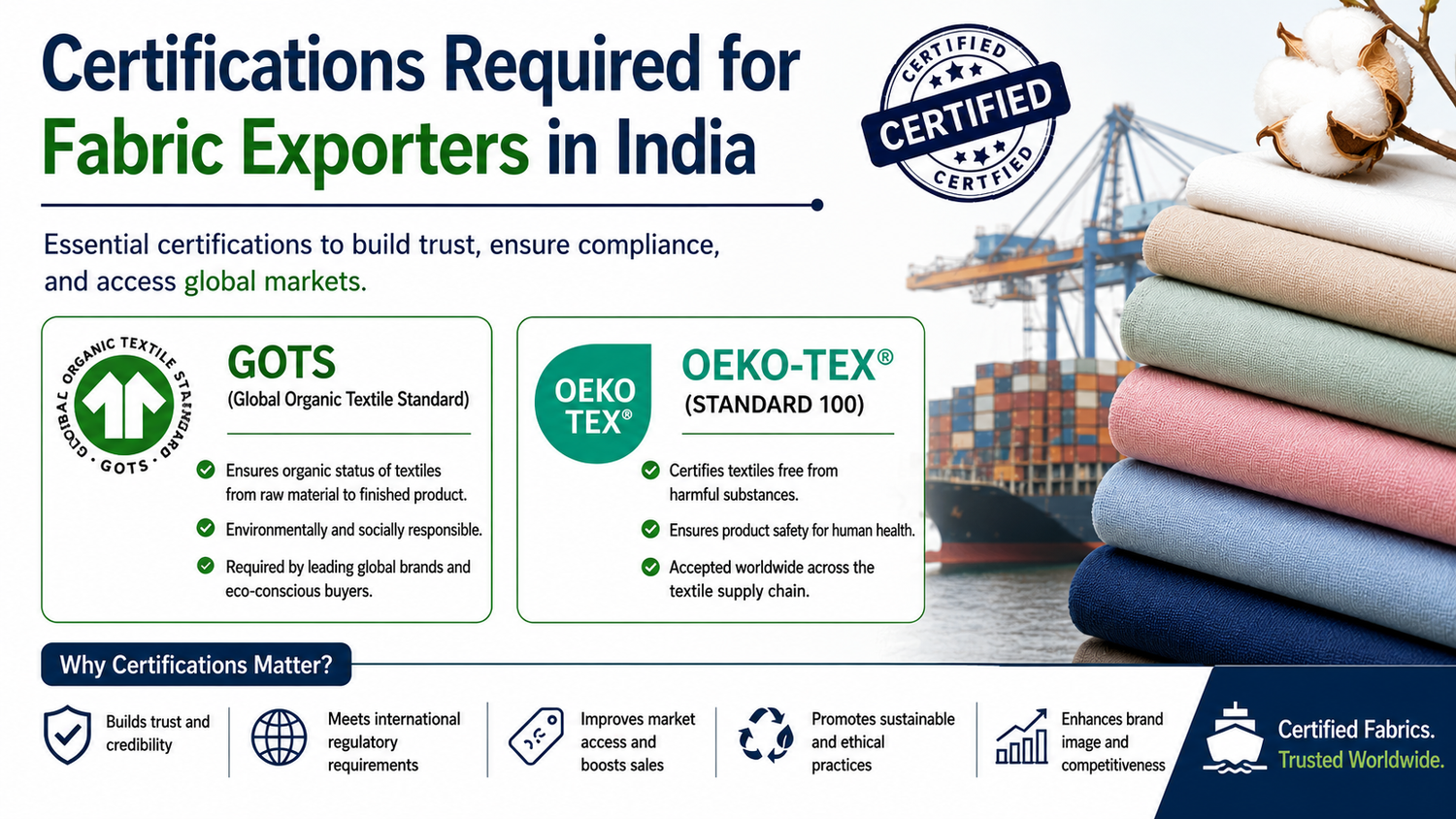
1. GOTS (Global Organic Textile Standard)
GOTS is one of the most important approvals for exporters of organic cotton fabric in India and other eco-friendly textiles. It verifies not only the raw materials but also the entire production process, making it very useful for markets around the world that care about the environment.
What It Covers:
- At least 70% of the fiber must be organic.
- An environmentally friendly procedure.
- Tough limits on dangerous chemicals.
- ethical labor and following the rules.
Why It Matters:
- Demanded by high-end and environmentally-friendly design brands.
- Important for Indian exports of organic textiles.
- Makes the whole supply line clear and easy to track.
2. OEKO-TEX® Certification
OEKO-TEX® is important for ensuring fabric safety and compliance, while GOTS is focused on being environmentally friendly. It's widely used by poly cotton fabric exporters in India and other textile manufacturers where chemical safety is important.
Key Standard:
- Standard 100 by OEKO-TEX®
What It Tests:
- There are harmful chemicals in the fabric.
- Safety for end users' skin.
- Limits on chemical residues.
Why It Matters:
- Strongly preferred by European and global buyers.
- Ensures textiles are safe for direct skin contact.
- Critical for babywear, lingerie, and sensitive apparel.
GOTS vs OEKO-TEX: Key Differences
Which certification to get depends on the type of goods you're selling and the people you want to sell them to. Many exporters use both to ensure they comply with the various rules in international garment manufacturing in India.
|
Factor |
GOTS |
OEKO-TEX® |
|
Focus |
Organic + Sustainability |
Chemical Safety |
|
Scope |
Entire supply chain |
Final product testing |
|
Fiber Requirement |
Organic fibers only |
Any textile |
|
Social Compliance |
Yes |
Limited |
|
Market Use |
Eco-conscious brands |
Mass & regulated markets |
👉 Simple Understanding:
- GOTS = How the fabric is made
- OEKO-TEX = Is the fabric safe to use
Other Important Certifications for Fabric Exporters in India
It might not be enough for companies that export bulk fabric to India to have just one or two certifications. There are additional rules that must be followed across markets and buyers, especially regarding quality, sustainability, and ethical sourcing.
Key Certifications:
ISO 9001
- Focus on quality management systems.
- Ensures consistent production standards.
Fair Trade Certification
- Ethical labor practices.
- Fair wages and working conditions.
BCI (Better Cotton Initiative)
- Promotes sustainable cotton farming.
- Widely accepted by global brands.
REACH Compliance (EU Regulation)
- Controls chemical usage in textiles.
- Mandatory for exports to European markets.
Step-by-Step Process to Get Certified
To get certifications for textile exporters in India, you need to plan, spend, and make sure your processes are aligned. It's not a one-time thing; there is a method in place that makes sure quality and consistency all the time.
Steps Involved:
Step 1: Assess Eligibility
- Evaluate raw material sourcing.
- Review current production processes.
Step 2: Upgrade Processes
- Replace restricted chemicals.
- Improve documentation and traceability.
Step 3: Apply Through Certification Bodies
- Work with authorized third-party agencies.
Step 4: Audit & Inspection
- On-site factory audits.
- Documentation verification.
Step 5: Certification Approval
- Certification is issued for a defined period.
- Requires periodic renewal and audits.
Challenges Indian Fabric Exporters Face
Certifications can help exporters get better deals around the world, but the process can be hard for some. It is very hard to keep everyone in the supply chain compliant, especially small and medium-sized businesses.
Common Challenges:
- High costs for audits and certifications.
- Requirements for complicated paperwork.
- Smaller producers don't know much about it.
- Having trouble keeping things consistent in big production.
- Compliance gaps at the supplier level.
Weak process control, not poor product quality, is the main reason why compliance fails most of the time.
How Modern Sourcing Systems Simplify Compliance
Many companies are switching to integrated buying systems to better manage apparel fabric sourcing in India amid rising compliance requirements. These tools simplify operations and improve certification management.
Key Benefits:
- Centralized quality control systems.
- Standardized production processes.
- Easier certification tracking and documentation.
- Reduced compliance and sourcing risks.
This move toward integrated sourcing helps importers stay competitive in global markets while maintaining quality and compliance standards.
Example: Fabriclore’s Structured Approach

As more buyers around the world demand textiles that are certified, traceable, and in line with the law, exporters can't depend on supplier networks that aren't connected. To meet standards like GOTS, OEKO-TEX, and REACH, your sourcing process needs to be more organized and transparent. Integrated systems like Fabriclore really shine here, making it easier for producers to follow the rules while maintaining the quality of all their orders.
They have 10+ years of experience, and 500+ global brands trust them. Fabriclore combines fabric development, production, and fabric sourcing into a single, controlled environment. This is especially helpful for organic cotton fabric in India and the exports of sustainable textiles.
What Makes This Approach Practical
- Access to 5000+ fabrics, including sustainable and certified-ready options.
- Centralized system for better traceability and documentation.
- 20-lakh-meter monthly capacity for scalable production.
- Easier compliance tracking for GOTS, OEKO-TEX, and global standards.
- Reduced dependency on multiple suppliers.
- Improved audit readiness and consistency in bulk orders.
This organized method helps sellers build trust, lower risk, and grow with confidence in world markets.
Fragmented Suppliers vs Certified Integrated Systems
As global compliance standards tighten, exporters who rely on fragmented supplier networks may face major problems. A lot of companies are switching to certified integrated systems that make it easier to keep an eye on, control, and make sure that all of India's fabric products are the same.
|
Factor |
Fragmented Suppliers |
Integrated System |
|
Compliance Control |
Low and inconsistent |
High and standardized |
|
Documentation |
Scattered across vendors |
Centralized and organized |
|
Risk |
High due to gaps |
Reduced with system control |
|
Audit Readiness |
Poor preparation |
Strong and audit-ready |
Future Trends in Textile Certification (2026 and Beyond)
The textile industry is undergoing a rapid transformation, and certifications are increasingly becoming a necessity rather than a choice. Staying abreast of compliance trends is essential for the long-term success of exporters engaged in bulk fabric export to India and international textile sourcing.
Key Trends to Watch:
- Increased demand for full supply chain traceability.
- Adoption of digital compliance tracking systems.
- Stricter global regulations on chemical usage.
- Rising demand for sustainable and eco-certified fabrics.
- Integration of certifications with sourcing platforms.
Simply put, compliance is no longer a choice; it is now a necessity in the global textile trade.
Conclusion
In 2026, certifications will be a must for any fabric exported from India. Buyers aren't ready to take chances on products that haven't been checked, so standards like GOTS and OEKO-TEX are important for getting into the market. The approval process can be hard to understand, but it builds trust, makes sure rules are followed, and gives businesses access to high-end global markets. Structured sourcing systems that make compliance easier and lower risk are the way of the future for both exporters and brands. This is because in global trade, proof is more important than claims.
FAQs
What Certifications Are Required To Export Fabric From India?
The most popular certifications needed to export fabric from India are:
- GOTS (Global Organic Textile Standard) – for organic textiles.
- OEKO-TEX® Standard 100 – for chemical safety and skin-friendly fabrics.
- REACH compliance – mandatory for exports to the European Union.
Exact needs depend on the product type, the market you want to reach, and what buyers want, especially in the premium and sustainable segments.
Is GOTS Certification Mandatory For Textile Exports From India?
GOTS certification is not required by law, but it is strongly suggested for shipping organic fabrics.
It's required by most major brands because it makes sure:
- Authentic organic fiber usage.
- Environmentally responsible processing.
- Ethical labor practices.
Without GOTS, it becomes difficult to access premium sustainable markets.
What Is The Difference Between GOTS And OEKO-TEX Certifications?
When exporting textiles, each qualification is used for a different reason:
- GOTS → Focuses on organic fibers and sustainable production.
- OEKO-TEX® → Focuses on chemical safety and human health.
To put it simply:
- GOTS = Sustainability + Organic.
- OEKO-TEX = Safety + Compliance.
A significant number of importers use both to meet the needs of buyers around the world.
How Long Does It Take To Get Textile Certifications In India?
Usually, it takes between 4 weeks and 3 months, but it depends on:
- Ready for the factory.
- Correct documentation.
- Scheduling an audit.
- Level of compliance.
It is possible to get approvals faster if systems and methods are already in line with certification standards.
Is OEKO-TEX Certification Required For Exporting Fabric To Europe?
Even though OEKO-TEX® isn't always required by law, European buyers strongly expect it.
This is very important for:
- Babywear and kidswear.
- Home textiles.
- Skin-contact garments.
Being OEKO-TEX certified builds trust with buyers, lowers the risk of not following the rules, and makes your products more popular in EU countries.
We also happen to be a magnet for suggestions, and would love to catch yours….throw us yours on hello@fabriclore.com
Learn, Create & Grow with us