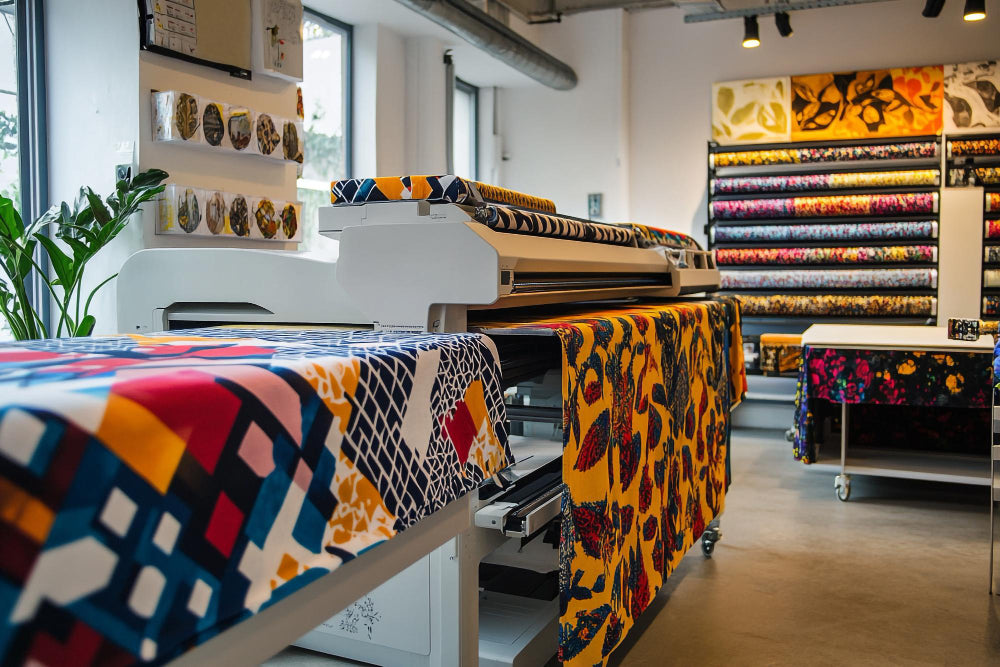
The digital printing on fabric industry in the USA has undergone a quiet revolution. What once required expensive screens, industrial minimums, and weeks of lead time can now be done from your laptop — with a single yard printed and shipped in under a week.
The cost of getting started has never been lower, whether you're an independent fashion designer trying a capsule collection, a home decor brand making a new pattern bigger, or a corporate buyer looking for custom fabric printing for branded goods. But quality standards have never been higher at the same time.
This guide is your complete resource for navigating digital fabric printing in the USA — from understanding the core technologies and fabric compatibilities to managing low minimum order quantities (MOQ), scaling to bulk fabric printing, vetting suppliers, and controlling print quality at every stage.
Quick Overview: What Is Digital Printing On Fabric?
Inkjet printers use digital artwork files to print dye or pigment directly on cloth surfaces. This is called digital fabric printing. It's cheaper for small runs, complicated designs, and on-demand fabric printing because it doesn't need actual screens or color separations as screen printing does. In the United States, you can buy it in any size from one yard to tens of thousands of yards.
What Is Digital Fabric Printing?

Digital fabric printing — also called digital textile printing— uses industrial inkjet technology to deposit dye or pigment directly onto fabric from a digital file. There are no screens, no films, and no chemical discharge from unused ink.
Since 2010, the process has grown significantly because of advancements in printhead technology, ink chemistry, and software. It was first commercialized in the 1990s. With strong infrastructure along both coasts and expanding industrial hubs in the Midwest and Southeast, the US digital textile printing market is now a multibillion-dollar component of the larger textile and apparel industry.
How Digital Fabric Printing Works — Step by Step
- Design creation: Artwork is prepared in a digital file format (TIFF, PNG, PDF, or AI) at the appropriate resolution and color profile.
- Fabric selection and pre-treatment: Depending on the ink system, fabric may be pre-coated to improve ink adhesion and vibrancy.
- Printing: Industrial inkjet heads put down very small drops of color or dye in very precise designs at speeds measured in linear meters per hour.
- Fixation: The printed fabric passes through a steam chamber (for reactive inks), a heat press (for sublimation), or a curing oven (for pigment inks) to permanently bond color to fiber.
- Post-processing: The fabric is washed, dried, and finished to remove excess ink and chemicals, then rolled or cut for shipment.
Why Digital Printing Has Replaced Screen Printing for Many Applications
- No screen setup costs (traditionally $30–$150 per color, per screen)
- Unlimited color complexity — photographic gradients print as easily as flat color
- Low MOQ fabric printing — as little as one yard is economically viable.
- Faster turnaround for samples and production
- Less water waste and reduced chemical use
Types of Digital Fabric Printing Methods Compared
Choosing the right digital textile printing method depends on your fabric type, end use, and budget. The five core technologies used by USA fabric printing services each serve a distinct substrate and application — from custom activewear fabric printing with sublimation to reactive inkjet printing for natural-fiber fashion collections.
- Dye sublimation locks color permanently into polyester.
- Reactive inkjet chemically bonds dye to cotton, linen, and modal — the gold standard for custom fashion fabric printing. Acid inks deliver unmatched vibrancy on silk and wool.
- Pigment inks work across most fiber types with the lowest production complexity — ideal for low MOQ digital printing.
- DTG suits finished garments at one-piece minimums.
Quick Comparison: Digital Fabric Printing Methods
|
Method |
Best Fiber |
Min. Order |
Color Vibrancy |
Washfastness |
Cost Level |
|
Dye Sublimation |
Polyester |
1 yard |
★★★★★ |
★★★★★ |
Medium |
|
Reactive Inkjet |
Cotton, Linen, Modal |
10 yards |
★★★★☆ |
★★★★★ |
Medium–High |
|
Acid Ink |
Silk, Wool, Nylon |
5 yards |
★★★★★ |
★★★★☆ |
High |
|
Pigment Inkjet |
Most fabrics |
1 yard |
★★★☆☆ |
★★★☆☆ |
Low–Medium |
|
DTG |
Cotton garments |
1 piece |
★★★★☆ |
★★★☆☆ |
High per unit |
Best Fabrics for Digital Printing
Picking the suitable fabric is essential for achieving the best results in digital printing on fabric USA. Different fabrics require different ink technologies, and selecting the correct combination improves color vibrancy, durability, and print quality.
Best Printing Method by Fabric Type
|
Fabric |
Recommended Method |
|
Cotton |
Reactive Printing |
|
Linen |
Reactive Printing |
|
Polyester |
Sublimation Printing |
|
Silk |
Acid Printing |
|
Modal |
Reactive Printing |
|
Recycled Polyester |
Sublimation Printing |
Common Fabric Applications
- Cotton and Cotton Blends – Ideal for fashion apparel, quilting, children's wear, and home textiles.
- Polyester and Synthetics – Best suited for activewear, sportswear, swimwear, and performance fabrics.
- Silk – Preferred for luxury fashion, scarves, lingerie, and premium garments.
- Linen and Natural Fiber Blends – Popular for resort wear, summer clothing, and home decor applications.
- Velvet – Suitable for decorative textiles and premium furnishing applications.
- Organza and Chiffon – Commonly used for lightweight fashion garments, scarves, and occasion wear.
- Knits and Jerseys – Ideal for t-shirts, athleisure, sportswear, and stretch garments.
- Canvas and Heavy Duck – Widely used for bags, upholstery, home decor, and promotional products.
Understanding MOQ: From Low MOQ to Bulk Fabric Printing
Minimum order quantity (MOQ) is the smallest amount a digital printing supplier will produce in a single run. Digital fabric printing has slashed traditional MOQs dramatically — making custom production viable for startups, indie designers, and emerging brands that screen printing never could serve.
MOQ Tiers at a Glance
|
Order Tier |
Quantity |
Cost/Yard |
Best For |
|
Print-on-demand |
1–9 yards |
$15–$40 |
Sampling, POD retail |
|
Small batch |
10–50 yards |
$8–$18 |
Capsule collections, test runs |
|
Mid-run |
50–250 yards |
$4–$10 |
Small brand production |
|
Bulk production |
250–500+ yards |
$2–$6 |
Established brands, wholesale |
1. Low MOQ Fabric Printing: Pros and Trade-Offs
Why it works for small brands:
- Test multiple colorways without overproduction risk
- Validate market demand before committing to inventory
- Sample yardage available from as little as 1–3 yards
What to expect:
- Per-yard cost runs 3–8× higher than bulk pricing
- Color matching precision can be harder at very small quantities
- Complex pre-treatment fabrics (reactive, acid inks) may have longer turnarounds
2. When to Scale to Bulk Orders
Move to bulk digital fabric printing when:
- A design has proven demand through reorders or wholesale inquiries.
- Your per-yard cost needs to fall below $6 to stay commercially viable.
- You can forecast 3–6 months of inventory with confidence.
- Your design is fully locked — no further color or repeat changes.
Cost breakpoint: For most apparel brands, the shift from small-batch to bulk economics happens between 150–300 yards per colorway.
3. Smart MOQ Strategies for Small Businesses
- Bundle colorways — combine multiple versions of one design to hit a supplier's minimum across SKUs
- Ask about rolling minimums — some suppliers allow monthly aggregate totals rather than per-order floors
- Use a hybrid model — sample and refine domestically at low MOQ; bulk produce at scale when the design is proven
Quality Factors That Define a Great Print

More than just bright colours are needed for good printing. The resolution, colour management, wash life, and cloth choice all have an effect on the end result.
1 Resolution and DPI
DPI (dots per inch) determines sharpness and detail in your custom digital fabric printing.
- Minimum: 150 DPI at final print size
- Recommended: 300 DPI for apparel and home decor
- Large-format rule: Banners viewed from 3+ feet can use 72–100 DPI; close-worn garments need 200–300 DPI minimum
2 Color Accuracy and ICC Profiles
Most digital textile printing methods don't use CMYK, but RGB instead. This is because inkjet systems mix primary dyes, not process inks. Always work with sRGB or AdobeRGB when making files.
Before submitting files, request your supplier's ICC profile. Applying it eliminates most color shift surprises. Skilled operators can match Pantone references within 2–3 ΔE — close enough for most apparel applications.
3 Washfastness Standards
Always ask suppliers for their AATCC colorfastness rating before placing a production order.
|
AATCC Rating |
What It Means |
|
5 |
Excellent — no color change after washing |
|
4 |
Good — slight change visible only in comparison |
|
3 |
Moderate — noticeable fading over repeated washes |
|
2 |
Poor — significant fading |
Minimum benchmark: AATCC 4 for apparel and home textiles; 4–5 for luxury applications.
4 Hand Feel and Drape
A print that stiffens the fabric kills the product — regardless of color quality.
- Pigment inks carry the highest risk of affecting hand feel at heavy coverage.
- Reactive and sublimation inks have minimal impact on drape.
- Always request a washed strike-off sample before bulk approval.
5 Print Registration and Repeat Accuracy
To be able for cut-and-sew cloth printing to work, your design repeat needs to line up perfectly across seams, pant legs and panels. Call out:
- Repeat dimensions (inches or centimeters)
- Bleed allowance (0.5–1 inch beyond cut lines)
- Fabric grain alignment for woven substrates
Poor registration is a legitimate ground to reject an entire production run.
Eco-certifications — OEKO-TEX, GOTS, and Bluesign — are covered in full in Section
How to Find and Vet a Digital Fabric Printer in the USA
Finding the right digital fabric printing supplier is the decision that most directly determines whether your production succeeds or stalls. The market divides into four distinct provider types, each suited to a different stage of brand growth.
Types of Providers
1. Print-on-Demand Platforms
Fully online, single-yard fulfilment, and no minimum order quantity (MOQ). Perfect for independent artists who want to try out ideas for printing on custom fabrics. The road to commercial pricing is the slowest and costs the most per yard.
2. Boutique Digital Fabric Mills
Small to medium-sized businesses that can choose from different types of fiber, ink systems, and finishing. MINs of 10 to 100 yards. It works best for brands that are going from samples to their first low-MOQ fabric printing runs.
3. Industrial Digital Textile Printers
Processing thousands of yards per week at high speeds. Best suited for bulk fabric printing where the cost per yard must be less than $5.
4. Full-Stack Production Partners
The fastest-growing and most strategically valuable category for scaling brands. These partners integrate fabric sourcing, custom digital printing, dyeing, and garment manufacturing under a single accountable roof — eliminating the fragmented supplier coordination that drains time and budget from growing brands.
Fabriclore: A Full-Stack Digital Fabric Printing Partner for Global Fashion Brands
Why US Fashion Brands Are Partnering With Fabriclore for Custom Digital Fabric Printing
For US-based fashion brands seeking custom digitally printed fabric at wholesale prices — with reliable lead times, scalable MOQs, and end-to-end production control — Fabriclore has emerged as one of the most trusted full-stack textile partners in the global market.
Headquartered in Jaipur, India, with 10+ years of expertise in dyeing and printing and global shipping to the USA, UK, Europe, Australia, and the Middle East, Fabriclore is built specifically for brands that need more than a printer — they need a production ecosystem.
What makes Fabriclore different from a standard digital printer:
Fabriclore is a technology-driven textile sourcing, fabric processing, and garment manufacturing partner — not just a print facility. It brings fabric sourcing, customization, dyeing, printing, and garment manufacturing under one integrated system, so brands move efficiently from product development to bulk production without managing multiple vendors.
By the numbers:
|
Capability |
Detail |
|
Fabric library |
5,000+ options across natural, sustainable, and blended textiles |
|
Digital printing MOQ |
From just 100 meters per design |
|
Monthly processing |
20,000+ meters per month |
|
Brands served |
500+ fashion businesses globally |
|
Sampling turnaround |
Pre-printed sample yardage shipped within 24 hours |
|
Production lead time |
Ready in 15 days |
|
Global shipping |
DHL, FedEx, UPS, ARAMEX |
What Fabriclore's End-to-End Digital Printing Process Looks Like
This is where Fabriclore's model genuinely differs from sourcing through independent print shops. Its proprietary quality process covers every stage of the custom fabric printing workflow:
- Fabric discovery and selection — choose from 5,000+ pre-sourced, certified fabrics including Cotton, Linen, Viscose, LENZING™ Modal, LIVA™, BEMBERG™ Cupro, Silk, and sustainable options like Organic Cotton and EcoVero™
- CAD design approval — your print layout is reviewed digitally before physical sampling begins
- Sample yardage — order a pre-printed sample online; ships within 24 hours so you can verify color fidelity, sharpness, and fabric hand feel before committing
- RFD (Ready for Dyeing) pre-treatment — fabric is properly prepared for the specific ink system being used
- Digital printing — executed on premium high-fidelity machines ensuring vibrant, accurate color reproduction and sharp contrast
- Post-production finishing — steaming, washing, and fixation as required by the ink and fiber combination
- In-house inspection and testing — Fabriclore's quality unit analyzes 20+ types of defects and conducts shrinkage and colorfastness testing on every order
- Global doorstep delivery — securely packaged, trackable shipment to the USA and 50+ countries
Fabric Options Available for Custom Digital Printing at Fabriclore
Fabriclore's customized digital printed fabric collection covers an extensive range of substrates suited to different ink systems and end uses:
- Cotton: 20s sheeting, 40s poplin, 60s airjet, 60s slub, 92×80 voile.
- Viscose and cellulosics: Birla Viscose, Liva Viscose Twill, Viscose Bosky Satin, Chinon Chiffon, Natural Crepe.
- Modal and blends: LENZING™ Modal Satin, VFY × Liva Modal, Bemberg × Modal Satin, Poly Modal Satin.
- Polyester and specialty: Poly Linen, Poly Organza, Poly Banglori Silk, Poly Muslin Jacquard.
- Linen blends: Cotton-Linen 70/30 blend.
This depth of substrate variety means US brands can source digitally printed cotton fabric wholesale, custom viscose print fabric, or sustainable modal digital printing — all through one partner, with consistent quality standards across every order.
Fabriclore's Competitive Edge for US Brands Scaling Production
The core problem Fabriclore solves for US fashion brands is fragmented sourcing — the expensive, time-consuming cycle of coordinating between a fabric supplier, a printer, a quality tester, a freight forwarder, and a garment manufacturer. Fabriclore collapses that into one relationship:
- Verified fabric authenticity — spec transparency including count, construction, weave, and fold length; you pay for exactly what you get.
- Lowest MOQ in the segment — 100 meters per design, enabling brands to test new prints commercially without large inventory commitments.
- Scalable production — the same partner handles 100-meter sampling runs and 20,000-meter monthly production programs, ensuring color continuity across order sizes.
- Technology-backed visibility — end-to-end order lifecycle automation provides real-time tracking across sampling, printing, and production stages.
- Sustainable options — Organic Cotton, TENCEL™, EcoVero™, Modal, and Linen with GOTS, FSC, and BCI certifications available on request.
- Private label garment manufacturing — available from low MOQs for brands ready to move from fabric sourcing to finished product.
For US brands navigating the critical transition from small-batch digital printing to bulk fabric production, Fabriclore provides the rare combination of boutique flexibility and industrial-scale capability — without requiring the brand to graduate to a different supplier at each growth stage.
Key Questions to Ask Any Supplier
Before placing an order, ask:
- What is your minimum order quantity?
- Can I order sample yardage first?
- What file formats do you accept?
- Do you offer Pantone color matching?
- What are your lead times?
- What washfastness standards do you follow?
- Are your inks OEKO-TEX certified?
- Which fabrics do you stock?
- Can I supply my own fabric?
- How do you handle quality issues?
Red Flags to Watch For:
Avoid suppliers that:
- Refuse to provide samples.
- Cannot explain their printing process.
- Offer vague color guarantees.
- Lack customer references.
- Provide no information about certifications.
- Cannot demonstrate previous work.
How to Evaluate a Strike-Off
A strike-off — typically 1–3 yards or meters produced before full production — is your quality gate. Check for:
- Color accuracy vs. your approved digital file
- Sharpness in fine lines, gradients, and detailed areas
- Hand feel and drape after printing
- Repeat alignment for cut-and-sew applications
- Color retention after a home wash test
Never skip the strike-off. A $40 test print can save you from a $4,000 reprint.
The Design-to-Print Workflow: Step by Step

Having an organized process makes things more consistent and cuts down on mistakes in production.
Step 1: Create Your Artwork
Popular software includes:
- Adobe Illustrator
- Adobe Photoshop
- Affinity Designer
- Canva Pro
Vector vs Raster
Vector files:
- Logos
- Line art
Raster files:
- Photography
- Complex illustrations
Step 2: Prepare Print Files
Recommended Specifications
|
Parameter |
Recommendation |
|
Resolution |
300 DPI |
|
Color Mode |
RGB or sRGB |
|
Formats |
TIFF, PNG, PDF, AI |
|
Bleed |
Include seam allowances |
Step 3: Order a Strike-Off or Sample
Never skip this stage.
A small sample allows you to verify:
- Colors
- Scale
- Fabric suitability
- Print quality
The cost of a sample is far lower than correcting an entire bulk run.
Step 4: Approve Production
A production-ready order should specify:
- Fabric type
- Pattern repeat
- Quantity
- Color references
- Delivery timeline
Communication that is clear cuts down on mistakes and delays.
Step 5: Inspect Upon Delivery
Immediately examine:
- Print quality
- Fabric defects
- Color consistency
- Yardage accuracy
- Packaging condition
Document issues with photos and notify the supplier promptly.
Industry Insight
The biggest reason successful brands achieve consistent results with digital printing on fabric in the USA is not simply choosing the right printer—it is following a disciplined workflow from artwork preparation to final inspection. Businesses that prioritize sampling, color management, and supplier relationships often experience fewer production issues and achieve better long-term profitability.
Pricing Guide: What Does Digital Fabric Printing Cost in the USA?
Digital printing on fabric USA costs vary based on the type of fabric, the printing method, the number of items ordered, the difficulty of the design, and the time it takes to complete the job. Larger orders usually have lower prices per yard, but prices may go up for unique fabrics and printing methods that aren't common.
Key Factors Affecting Cost
- Printing method (reactive, pigment, sublimation, DTG, or acid printing)
- Fabric type and quality
- Order volume
- Design complexity and color coverage
- Production timeline and shipping requirements
Estimated Price Ranges
|
Order Type |
Estimated Cost |
|
Print-on-Demand |
$15–$40 per yard |
|
Small Batch (10–50 yards) |
$8–$18 per yard |
|
Mid-Scale Production (50–250 yards) |
$4–$10 per yard |
|
Bulk Orders (500+ yards) |
$2–$6 per yard |
Additional Costs to Consider
- Sample or strike-off fees
- Shipping and logistics
- Artwork adjustments
- Color matching services
- Rush production charges
Businesses can better plan their budgets and pick the best custom fabric printing option for their needs when they know about these cost factors.
Top Use Cases Across Industries
Digital printing on fabric USA has found more uses in many fields because it is so flexible. With on-demand fabric printing for home decor and branding goods and custom fabric printing for fashion collections, businesses can make one-of-a-kind patterns with less inventory risk and faster turnaround times. Because digital textile printing can do both low MOQ fabric printing and bulk fabric printing, it can be used by new businesses, well-known brands, and creative companies.
Popular Applications
- Fashion and Apparel – Custom prints for clothing, swimwear, and limited-edition collections.
- Home Decor and Interior Textiles – Curtains, cushions, upholstery, and bedding.
- Activewear and Sportswear Sublimation printing is used for team outfits and sportswear.
- Corporate Merchandise – Branded fabrics, bags, displays, and uniforms.
- Print-on-Demand Businesses – Inventory-free textile and apparel sales.
-
Quilting and Craft Fabrics – Personalized patterns, artwork, and specialty fabric projects.
Sustainability and Ethical Sourcing
Why Digital Printing Is More Sustainable
Digital textile printing offers meaningful environmental advantages over screen printing:
- Water use: According to the Textile Exchange environmental studies, digital printing uses 50–80% less water than traditional screen printing and dying.
- Ink efficiency: Only the ink needed for the design is deposited — no leftover ink baths.
- Overproduction elimination: On-demand fabric printing means no unsold inventory going to landfill.
- Chemical waste: No screen-making chemicals, no discharge of unused dye baths.
Certifications That Matter
|
Certification |
What It Covers |
|
OEKO-TEX Standard 100 |
Inks and finished fabric contain no harmful substances |
|
GOTS |
Organic fiber + chemical processing standards |
|
Bluesign |
Responsible resource use in textile chemistry |
|
ZDHC MRSL |
Zero Discharge of Hazardous Chemicals in manufacturing |
How to Avoid Greenwashing
Terms like eco-friendly and sustainable printing have no legal definition in the USA. Ask for:
- Certification numbers you can verify independently
- Ink manufacturer's Safety Data Sheets (SDS)
- Water treatment documentation for reactive ink wash steps
Sustainable Fabric Choices to Pair With Digital Printing
- TENCEL™ (Lyocell): Closed-loop production, excellent for reactive ink printing.
- Organic cotton: GOTS-certified versions available from US and overseas mills.
- Recycled polyester (rPET): Works with sublimation inks; made from post-consumer plastic bottles.
- Recycled nylon: ECONYL® is a popular choice for swimwear and activewear.
USA vs. Overseas Fabric Printing: Which Is Right for You?
Side-by-Side Comparison
|
Factor |
USA Domestic |
Overseas (Asia/Europe) |
|
Lead time |
1–3 weeks |
4–14 weeks |
|
Cost per yard |
Higher |
Lower (at volume) |
|
MOQ |
Low (1–50 yards) |
Often higher (100–500+ yards) |
|
Communication |
Easy; same time zone |
Can be complex; time differences |
|
IP protection |
US law applies |
Variable; enforcement harder |
|
Quality control |
On-site visits possible |
Remote only (or travel required) |
|
Sustainability |
More transparent |
Variable; harder to verify |
|
Shipping carbon footprint |
Lower |
Higher |
When to Choose USA Domestic Printing
- Speed is critical: New collection launches, replenishment orders, trend-responsive products
- You need low MOQ: Testing designs without bulk commitment
- IP is sensitive: Original prints at risk of copying
- Sustainability messaging matters: "Made in USA" and domestic certifications support brand story
- Quality control: When you need to inspect production before shipment
When Overseas Makes Commercial Sense
- Volume is high, and design is locked: 500+ yards of a confirmed bestseller
- Cost per yard must fall below $4: Domestic production rarely reaches this level
- Longer lead time is acceptable: Off-season orders placed months in advance
- Commodity fabrics: Standard substrates available at lower cost overseas
The Hybrid Strategy
The most sophisticated brands use both:
- Sample and refine domestically — fast, affordable, no IP risk
- Bulk produce overseas — once design is approved, and demand is proven
-
Emergency reorder domestically — when a style outsells forecast and overseas MOQ is too high
Conclusion
Digital printing on fabric USA has transformed the way businesses create custom textiles, making it easier to produce everything from small test runs to large-scale production. Whether you need low MOQ fabric printing, custom fabric printing, or bulk fabric printing, success depends on selecting the right fabric, printing method, and supplier.
Before you place an order for production, you should always ask for a sample or strike-off to make sure the colours are correct, the print quality is good, and the fabric works well. When looking at fabric printing services in the US, you should think about things like quality standards, turnaround times, eco-friendly practices, and the ability to produce.
As demand for on-demand fabric printing and personalized textiles continues to grow, digital printing remains one of the most efficient and scalable solutions for fashion brands, designers, home decor businesses, and product manufacturers.
Frequently Asked Questions
1. What Is the Minimum Order for Digital Fabric Printing in the USA?
The seller sets the minimum order amount. Many sites for on-demand fabric printing take orders as little as one yard, while low MOQ fabric printing from custom production suppliers usually starts at 10 to 50 yards. Most of the time, bulk output starts at 500 yards or more.
2. Is Digital Printing on Fabric Durable and Washable?
Yes. High-quality digital printing on fabric USA offers excellent wash durability when the correct ink and fabric combination is used. Reactive and sublimation printing are known for strong color retention and long-lasting performance.
3. What File Format Is Best for Custom Fabric Printing?
Most fabric printing services in the USA prefer high-resolution TIFF, PNG, PDF, or AI files. For the best print quality, artwork should be prepared at 300 DPI with accurate color settings.
4. Can I Print on My Own Fabric?
Absolutely. Fabriclore customer-supplied fabric printing. Before placing an order, confirm that your fabric meets the supplier’s requirements for fiber content, width, weight, and print compatibility.
5. How Long Does Digital Fabric Printing Take?
Production timelines vary by order size. On-demand fabric printing orders may take a few days, while custom and bulk fabric printing projects typically require one to six weeks, depending on quantity and complexity.
6. What Is the Difference Between Sublimation and Direct-to-Fabric Printing?
Sublimation printing fabric works best on polyester and synthetic materials, producing vibrant and durable results. Direct-to-fabric printing is commonly used for cotton, linen, silk, and other natural fibers, offering excellent softness and color quality.
7. Is Digital Fabric Printing Suitable for Small Businesses?
Yes. Startups, designers, and small brands can use low-MOQ fabric printing to try out new designs, lower the risk of running out of stock, and release collections without having to spend a lot of money on big production runs.
8. How Much Does Custom Digital Fabric Printing Cost in the USA?
The cost of custom fabric printing depends on the fabric type, printing method, order quantity, and finishing requirements. Small orders generally cost more per yard, while larger production runs benefit from lower unit costs and improved production efficiency.
We also happen to be a magnet for suggestions, and would love to catch yours….throw us yours on hello@fabriclore.com
Learn, Create & Grow with us